Prior to explaining why I have made a breakthrough that will change the face of chord playing instruments for all mankind (or not), let’s catch up on where we are now. As I am writing this KAME has had it’s first in person class for the semester, which was the first dedicated class to the chord instruments we have chosen. These activities are supplemented with “contemporary pedagogies” work to be done in our own time, to give us even more scope for our future profession, mainly in terms of exploring the work of notable music educators who have pushed the boundaries for our profession. This also reminds me that I will have to write a post dedicated to the first six weeks worth of discussions (that supplemented the introductory Kodaly course in the first half of our KAME classes.
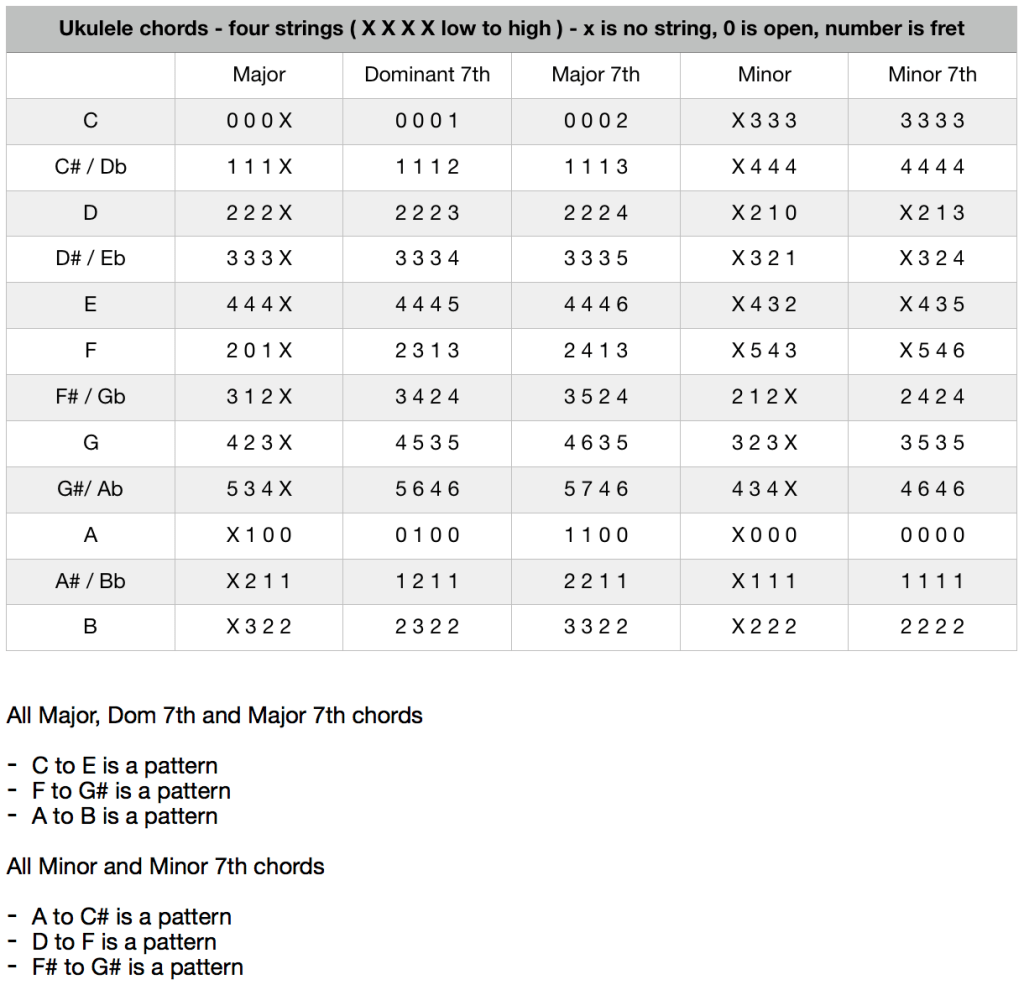
Now, time to get real. After sitting down with my ukulele this week, I rolled my eyes and thought how can I possibly come up with a practical and foolproof system (or in this case me-proof) for ukulele chords in time for the performance day? Sometimes in life it is these challenges that lead to breakthroughs, whether they are great or small in scope. I have in fact managed to create an excellent system for myself; in essence there are still inevitably several physical chord shapes to learn, yet they follow a perfect pattern by which the patterns change through the twelve note system based on what would be the relative minor notes! (meaning the patterns change at the same time according to relative minor tonics… if that makes sense). C to E major, dominant 7th and major 7th chords each have one parallel pattern (mind you i managed to find shapes for these chord types that remain mostly the same with one note alterations here and there based on adding 7ths and such). F to G# of the same three types have parallel patterns, then A to B all have patterns. If you shift those note names/ranges all down by three semitones (to the relative minor tonics… see where I’m going with this?) then you have parallel patterns for all minor and minor 7th chord shapes. As mentioned, there are still the physical chord shapes to learn, and no direct relation between the major and minor shapes, but all the shapes change based on this pattern of relative minor/major root notes, with all three types of major chords staying in one position and modifying one note as needed, and the two minor chord types for each root note staying in the same basic shape but one note changes whether it is a triad or a 7th chord (even though I’m just using root, 3rd, 7th for minors). That’s about it for this week, I’m just glad that I could figure this out once and for all, and that seems to be achievement enough, the chord shapes I’m using now are both logically organised and sound musical. I should mention that this process was inspired by the first chord instrument class we just had this week, with my own mathematical spin on it to find a system that works for me : (hopefully the last time I post a boring screenshot of this chord chart, this is THE one I will be sticking with)

 Mitchell Davis Music Education Study Blog 2019-22