I’m going to be honest here; I think I have begun to enjoy the ukulele a little more now in the past week or so, given my updating of my chord chart to learn table. Here is another updated version with some new columns which are currently unfinished although I am going to task myself to finish those by next time you hear from me :
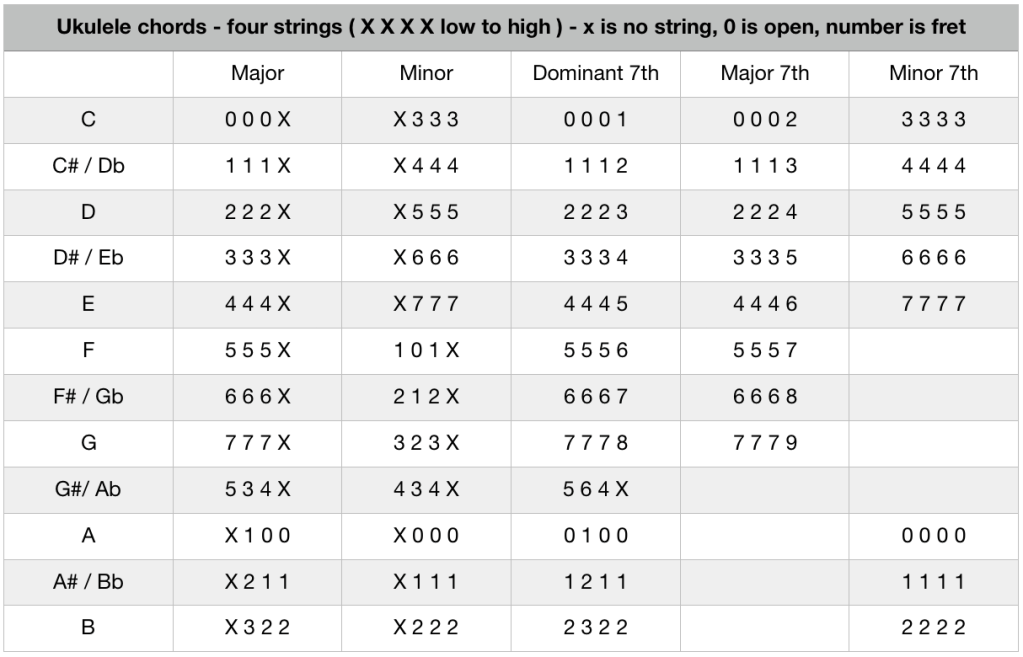
The two new columns are for major 7th and minor 7th chord shapes through the 12 notes, beyond just the dominant 7th shapes. Last week it became apparent to me that my laziness in simply playing a C major chord without the third fret note on the high string, opting for a lovely and simple 0 0 0 X chord shape with no left hand fretting required opened up some possibilities. I am aware that in James’ (Humberstone) ukulele diary he learnt C major with that high note, so I played it and realised it is simply a doubling of the root. Shortly after I realised this means I can shift this high note around to add notes to the triad, namely the major 7th interval by moving it down from 3 to 2. Simultaneously, it occurred to me that I had basically already used this method when deciding on my Dominant 7th shapes to use (eg. C major dominant 7 is 0 0 0 1). The minor 7th chord shapes I landed on happened even easier than that. By recognising that the majority of the minor chord shapes I am using are parallel patterns on the higher 3 strings, this leaves behind the lowest (in space) string. This lowest string is a whole step below the highest string (the root note string for the minor chord shapes) meaning that a minor 7th for any root of A-E can be achieved by simply playing the same fret on the low string (eg. A min is X 0 0 0, A min7 is 0 0 0 0). I may or may not have mentioned last week that this mathematical and pattern based method of creating chord shapes for myself comes from not really enjoying the ‘all over the place’ style employed by a lot of the online ukulele lessons, despite that quality of instruction by instructors such as the fantastic Justin Sandercoe (not sponsored by the way!).
Moving on, I decided to learn a constant personal favourite and surely the greatest songs ever to just have a riff, a one chord vamp for a pre chorus, and a chorus which uses the same chords as the riff; Highway to Hell by AC/DC. Although it was less than two minutes to work out my shapes and use my chart for assistance to play the A, D and G chords, I decided to be proactive when I encountered a problem. The D to G change in my system requires a sudden move from the second fret barre to the seventh fret. In heavy metal this wouldn’t be an issue, but on a ukulele, it sounds rather strange and does not translate to this adorable unplugged instrument. I chose to keep the 222 D chord and opt for use a G major shape of 423. I was able to work this out based on the fact that my G# major shape is 534, so moving down one step resulted in G that is appropriately close physically and musically to the D chord. The pre chorus on E is awkward considering that a guitar’s E chord is meant to be lower than an A chord, but hey, you can’t win ’em all.
It’s also great to be able to play Highway to hell and not have to care that Mal and Angus recorded their guitars tuned somewhere between E and Eb, because the octave difference with the ukulele makes my ear oblivious to the difference. Imagine being Bon Scott and learning to sing along to guitars and bass that are technically microtonal… RIP Bon Scott.

 Mitchell Davis Music Education Study Blog 2019-22