What’s that I hear you ask? Not all music students are crazy about the chorale from yesterday’s class? Never fear, a brand new synth is here. This week in technology in music education we explored some of the fundamental elements of modern electronic music, along with some of the basic principles for the science behind sound waves travelling through the ear, amplification and hearing a sound.
First of all, the basic science behind sound waves. When a sound is created by someone playing an instrument, that instrument will cause air to start moving which travels to a listener’s ear as well as to walls and other hard surfaces, bouncing back and forth adding reverberation. If a sound requires amplification, a microphone can be used to capture the sound and send it to a speaker. The speaker will move back and forth to imitate the shape of the sound wave passing through the air in order to recreate the sound. The shape of a sound wave can easily be seen when recording audio into a DAW.
James took us into a shared sound trap session in which he had prepared several tracks with basic synth patches. We looked at the sound of different basic wave shapes including sine, square, triangle and sawtooth. We then looked at ADSR envelopes for controlling both amplitude and frequency for the synth sound. Having recently finished a dance track for my contemporary music class, I am familiar with just how easy it can be to use synth sounds to layer musical ideas and create a piece of music that is fun in the making and as an end product.
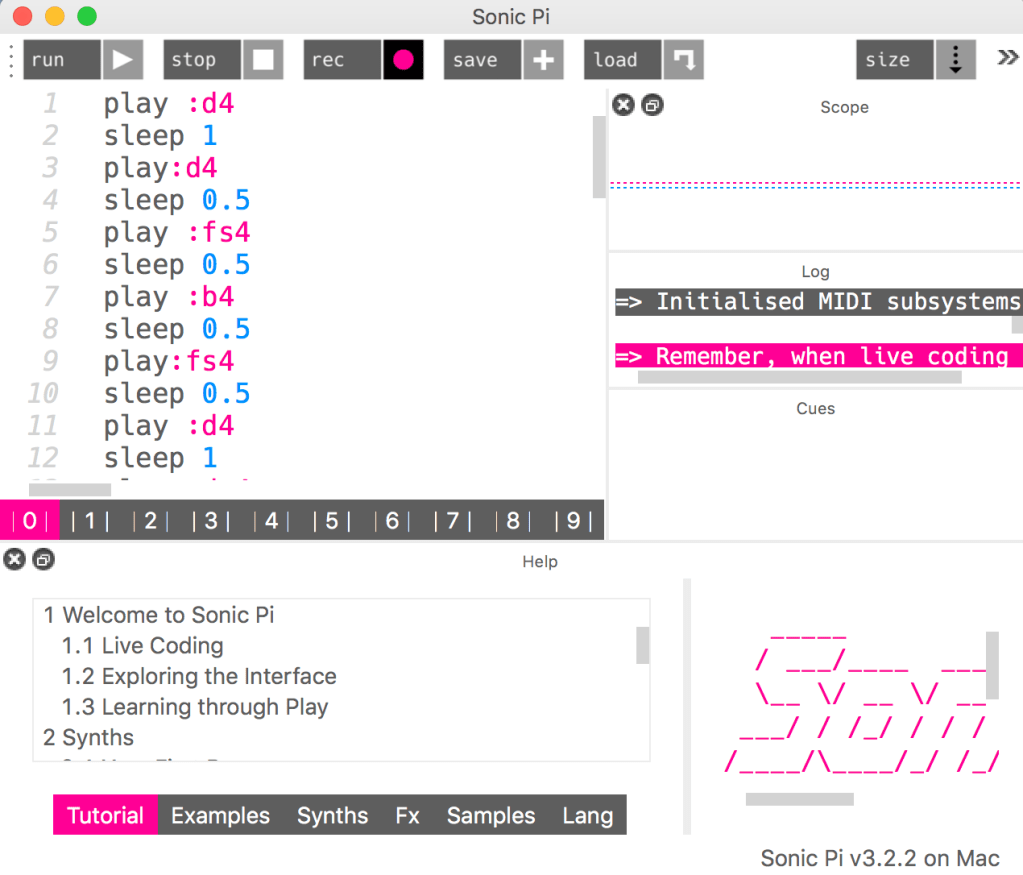
Later, we explored an application called sonic pi, a program that combines programming with composition. While I am yet to discover it’s full potential, my peers and I enjoyed making some strange new sounds and creating famous tunes through programming. Here is a screenshot of me programming a recent solfege exercise :
Modern electronic music definitely deserves a place in modern music education as it is has become an integral part of the modern popular music landscape. Electronic artists are wildly popular and praised for their creative and technical abilities.
Thank you for reading
Mitchell

 Mitchell Davis Music Education Study Blog 2019-22